
OSUN STATE
Introduction
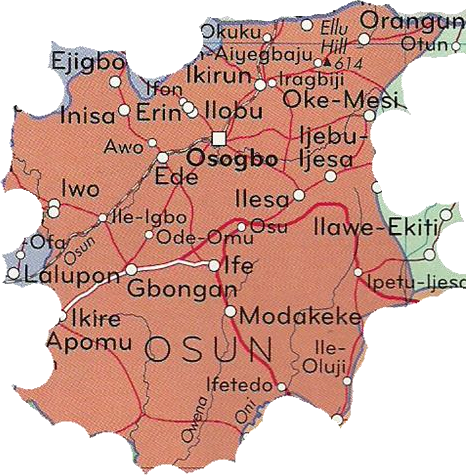
The Osun State Governorship election was held on Saturday, the 22nd of September 2018.There are 30 local governments, 322 wards, and 3010 polling units in the state.
According to the Independent National Electoral Commission (INEC), there are 1,682,495 registered voters, 1,246,915 (74.11%) collected PVCs; and 435,015 (25.86%) PVCs yet to be collected (PVCs of 565 registered voters are not accounted for).
Of the registered voters, 807,598 (48%) are males while 874,897 (52%) are females. 4,761 card readers were procured for the exercise.
The AID was accredited to observe the election on 27th August 2018. The mission opted for a Short-Term Observation
Project. The 2015 General Election’s Legal Framework was adopted by INEC for the conduct of the Osun polls.
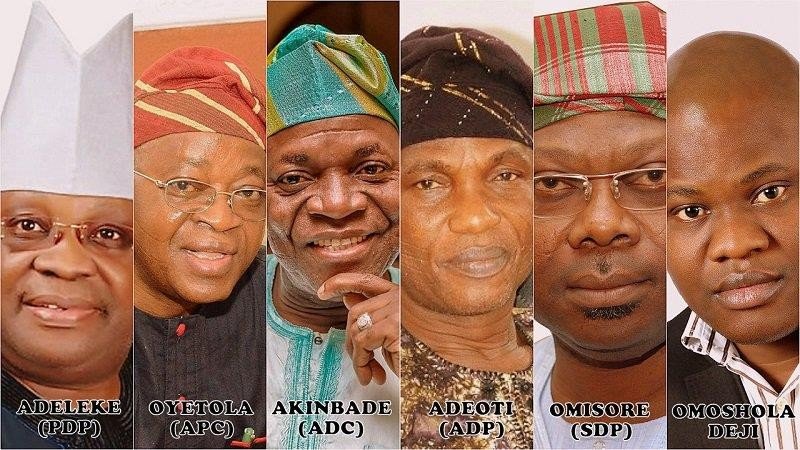
The election was declared inconclusive by INEC. A rerun was held on Thursday, the 27th of September 2018. There were 48 candidates from 48 political parties running for the gubernatorial seat, but the strong contenders were Gboyega
 Oyetola of the All Progressives Congress (APC), Senator Ademola Adeleke of the People’s Democratic Party (PDP), and Senator Iyiola Ajani Omisore of the Social Democratic Party (SDP).


Deployment

A section of The AID Roving Supervisory Team with GAAF Observer Team
On Wednesday, September 19th, 2018, the observers were deployed to the state. The AID observation team deployed to Osun state was led by Ms. Ada Enemuoh. A total of 51 observers were deployed to the state. There were 10 static observer teams stationed in 10 local governments, and one roving supervisory team.
On Thursday, September 20th, 2018, the team representatives attended “INEC briefing of all Accredited Observer Groups for the Osun State Governorship Election”. At the event, INEC laid out all the rules and regulation of the observation
exercise. Observers had a chance to ask questions, interact with the commission’s officials and understand the guiding principles of the mission. On Friday, September 21st, 2018, the team picked up the supplies needed on the polling day from the Osun State INEC Headquarters, Osogbo.
Polling Units
INEC required polling units to open at 8 a.m. Most polling units opened on time.
Time
OPEN BEFORE 8am Open After 8am
Polling Units were designed to conduct a free and fair election. The voting materials were publicly displayed. The INEC staff, party agents, observers, security personnel and voters were properly identified, and had their specific sitting / standing area. For the most parts, there was no campaigning in and around the polling units. Most polling units had enough security personnel to maintain law and order.

Table Measuring Scale
1 – Very Poor 5 – Average
10 – Very Good
Access to Polling Unit: APU Polling Unit Security: PUS
Availability of Electoral Materials: AEM Punctuality of INEC officials: PIO Election Observers Present: EOP
Abbreviation Meanings
Relative Ease of Accreditation and Voting: REAV Adherence to INEC Rules and Regulations: AIRR Card Reader Function: CRF
Noble Leadership Initiative: NBI Centre For Transparency and Advocacy: CTA
| S/N | L.G. A | Polling Unit (PU) | Ward | APU | PUS | AEM | PI0 | REAV | AIRR | CRF | EOP |
| 1 | Osogbo | St. Andrews (9) | Baba Kekere (011) | 10 | 10 | 10 | 10 | 10 | 10 | 10 | ACE, TMG, GPR-VON |
| Railway Station (05) | Ata Oja E | 10 | 10 | 10 | 10 | 8 | 10 | 8 | |||
| 25 Ibokun Road (007) | Ekerin (015) | 10 | 10 | 10 | 10 | 10 | 10 | 10 | |||
| Ojude Oga (010) | Oke – Baale | 10 | 8 | 10 | 10 | 10 | 10 | 10 | |||
| 2 | Atakumosa West | Methodist Prim. School (2) | Osu (3) | 10 | 10 | 10 | 10 | 10 | 10 | 10 | |
| 3 | Ife Central | Akarabata Line 1 | Akarabata | 10 | 5 | 9 -no marker | 10 | 9 | 10 | 9 | European Union, etc |
| 4 | Ede South | Obalaoye (4) Opp. Baptist church | Alajue 1 | 10 | 10 | 10 | 10 | 9 | 10 | 9 | |
| Obaladye School 2 (005) | Alajue 1 | 10 | 10 | 10 | 10 | 10 | 10 | 10 | Noble Leadership Initiative |
| Sekona 08 | Alajue | 10 | 10 | 10 | 10 | 10 | 10 | 10 | |||
| 5 | Ede North | Camp Young Area (005) opp. Saw mill | Sabo / Agbongbe 2 | 10 | 10 | 10 | 10 | 10 | 10 | 10 | GPR-VON |
| 150A Station Road | Isibo / Buari | 10 | 10 | 10 | 10 | 9 | 10 | 9 | YIAGA | ||
| 6 | Ife East | Comm. Primary School Oke -Ola 2 | Modakeke 3 (010) | 10 | 10 | 10 | 10 | 8 | 10 | 8 | |
| Ife City College | Ward 1B | 10 | 10 | 10 | 10 | 10 | 10 | 10 | CTA | ||
| 7 | Ilesa East | Olumilagbala | Bolorunduro | 10 | 10 | 10 | 10 | 8 | 10 | 8 | |
| 8 | Ilesa West | African Church (010) | 10 | 10 | 10 | 10 | 10 | 10 | 10 | ||
| 9 | Boripe | St. Luke Primary. Sch. 1 | Ororuwo | 10 | 10 | 10 | 10 | 10 | 10 | 10 | |
| Ile Alade 002 | 10 | 10 | 10 | 10 | 10 | 10 | 10 | ||||
| 10 | Obukun | Erinja Market (007) | 10 | 10 | 10 | 10 | 10 | 10 | 10 | ||
| Esa Oke Grammar School 010 | 10 | 10 | 10 | 10 | 10 | 10 | 10 | ||||
| Kiloru Ang. Primary School | 005 | 10 | 10 | 10 | 10 | 10 | 10 | 10 |
| 005 | Adaowode 005 | 10 | 10 | 10 | 10 | 10 | 10 | 10 | US Embassy |
Accreditation of Voters
Accreditation and voting were done simultaneously. Late accreditation was witnessed at some polling units. Officials cited the failure of card readers as the reason behind the delay in the accreditation exercise. Card readers identified the images of most voters but failed to capture their fingerprints.
Polling Units Accreditation Time
Early Accreditation and Voting
Late Accreditation and Voting
Card Reader Perfornace
Number of Finger Prints Rejected Number of Finger Prints not Rejected
Balloting
The voting exercise was mostly conducted in a free and orderly manner. Materials were almost adequately provided for the poll conduct. The voters displayed lot of enthusiasm and willingness to participate in the process. The presiding
officers displayed the empty ballot boxes to the voters before voting commenced. The mission observed no major violence or interference from party agents, candidates, INEC officials and the security forces. There was a good representation of security personnel and domestic observers at some polling units, especially those in the LGA of the governorship candidates; while in others, there were less security personnel and no observers. However, the mission observed that some polling units were overcrowded, exceeding the 750-maximum number of voters stipulated by INEC. An example of such polling unit is Akarabata Line 1 in Ife Central Local Government Area. The polling unit was in a compound with about 11 other polling units. As a result, the area was overcrowded with voters, security agents, observers, etc. Voters were not sure of which unit was theirs. Some became frustrated and threatened to leave. The growing agitation between some voters and INEC officials made the area violence-prone.
The polling booths were mostly designed to protect the secrecy of the ballot. It was mostly located behind and / or beside the INEC officials. Movement into the booth was restricted to one voter at a time. The polling booths were mostly placed close to the ballot boxes. Each person casts their votes at the cubicle., then throws the ballot paper into the ballot box.
However, there were some polling units that had polling booths with less restricted movement; as a result, altering the secrecy of the ballot. An example of such polling unit is Ojude Oga 010 in Osogbo LGA. The distance between the voting cubicle and the ballot box was too far away, exceeding the minimum distance stipulated by INEC. The effect is that
by-standers could see what party a person voted for; making vote buying possible.
Note: The AID officials didn’t physically observe any vote buying
Collation

Most polling units closed on or before 4pm, the official time stipulated by INEC. Counting was mostly done in an open and transparent manner by INEC officials in the presence of the voters, observers, security personnel and party agents.
The results were publicly announced by the presiding officer. An example of such polling unit was Methodist Primary School 002 in Atakumosa West LGA. Here, the counting was peaceful, and the electorate noted the individual number of votes casted for each candidate.
The mission observed collation take place at various wards and Local Government headquarters. At most collation centres, the mission did not observe any major discrepancy in the counting of the ballots. Most party agents seemed to agree with the result.
Announcement

The mission headed back to the state collation centre at INEC headquarters in Osogbo for final collation and announcement of result. Announcement of the results started at about 3a.m on Sunday, the 23rd of September 2018. The announcement was done in breaks as the results were coming in batches.
However, around 9. 30a.m, an uproar was heard outside the building. The mission went out to ascertain the reason. A middle-aged man named Salawu Mutiu Kolawole, with an INEC identification card was circled and shamed by party agents, media personnel, etc.


Upon questioning, the mission ascertained that he was accused of tearing a result sheet issued at the collation centre in Gbongan, Ayedaade L.G.A, Osun State. After much chaos and ado, a senior INEC official saved the situation by whisking the accused away from the scene. The mission did not see the accused commit the crime; as a result, may not be able to ascertain if the accusation was true or false. However, INEC issued a statement, certifying that the published figures were wrong and needed to be corrected, hence the tearing of the result by the official. Announcement of the collated result continued after the fact.
INEC COLLATION OF RESULTS FOR THE 2018 OSUN STATE GOVERNORSHIP ELECTION
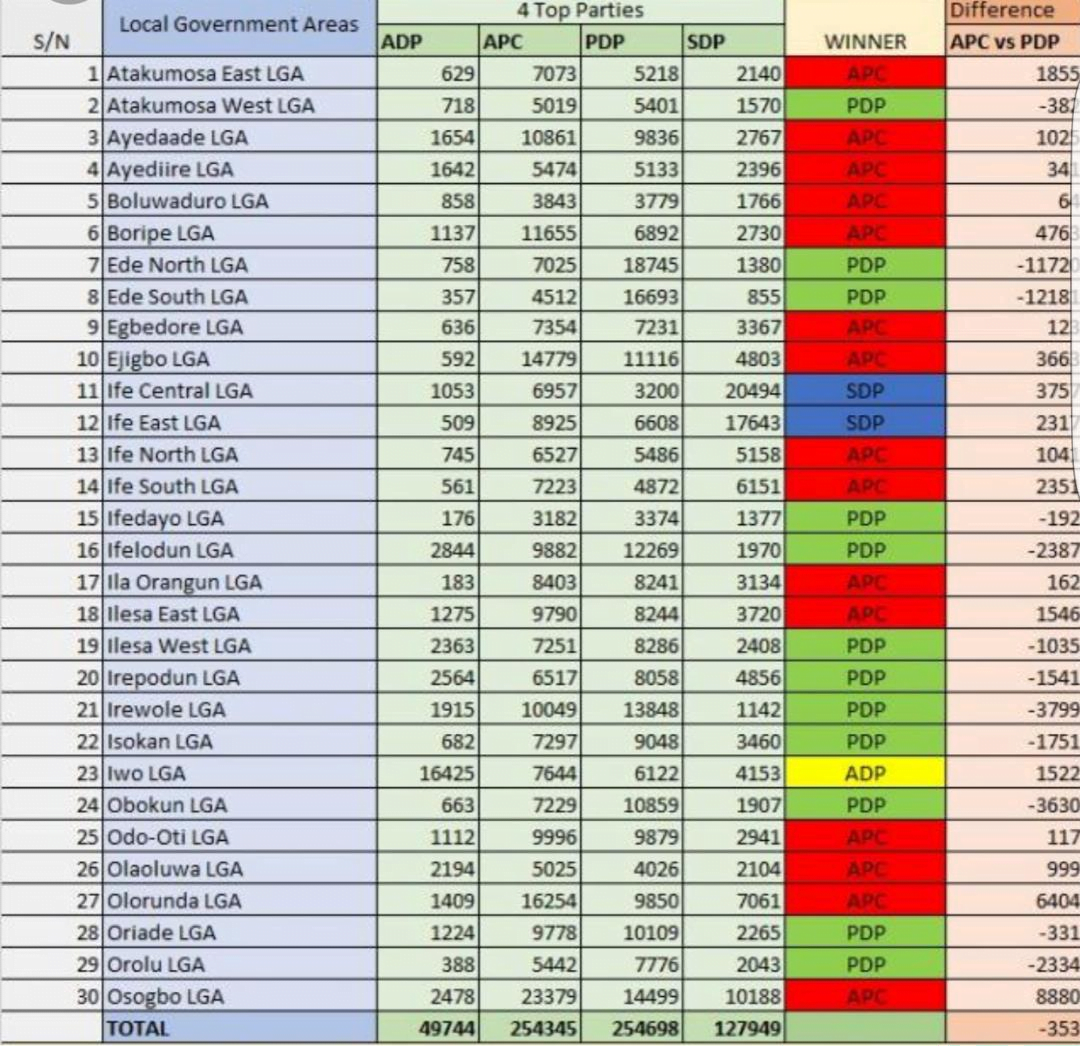
By a simple majority of 353 votes, the PDP candidate won the election. Also, the electoral process in seven polling units
with 3, 498 votes were cancelled for varying reasons. The 2015 General Elections Legal Framework advises the Returning Officer as follows : “Where the margin of win between the two leading candidates is not in excess of the total number of registered voters of the polling unit(s) where elections were cancelled or not held, decline to make a return until another poll has taken place in the affected polling unit(s) and the result incorporated into a new form, form EC 8D and subsequently recorded into Form EC 8E for Declaration and Return.”
Because the cancelled votes were more than the difference between the two top candidates, Professor Joseph Fuwape, the Returning Officer declared the election inconclusive. A rerun of the election in the seven affected polling units was slated for Thursday, the 27th of September 2018.
2018 OSUN STATE GOVERNORSHIP ELECTION RERUN
Introduction
The Osun State Governorship election rerun was held on Thursday, the 27nd of September 2018. Below are the seven polling units affected:
| S/N | L.G. A | Ward | Polling Unit | Total Number of Registered Voters at the Polling Unit | Reason for Initial Cancellation |
| 1 | Ife North | 10 | 2 | 353 |
|
| 2 | Ife South | 8 7 | 10 12 | 1314 |
|
| 3 | Orolu | 8 8 9 | 1 4 3 | 947 |
|
| 4 | Osogbo | 5 | 17 | 884 |
|
Initially, all 48 candidates from 48 political parties were in the ballot. The strong contenders were Gboyega Oyetola of the All Progressives Congress (APC), and Senator Ademola Adeleke of the People’s Democratic Party (PDP).
On Wednesday, the 26th of September 2018, the second runner up at the principal election, Senator Iyiola Ajani Omisore of the Social Democratic Party (SDP) opted out of the race. He endorsed and pleaded his supporters to vote for
the APC candidate, Mr. Gboyega Oyetola; stating that the candidate accepted to lead by …. “the principles of what the SDP stands for – good governance, social justice, and accountability”. This seemed to raise bitterness in the circles of the opposing camp (s).
Deployment
 On Wednesday, September 26th, 2018, the observers were deployed to the state. The AID observation team deployed to Osun state was led by Ms. Ada Enemuoh. A roving observation team of Five were deployed to the state for the mission.
A cross section of The AID and Women Arise for Change Initiative Observer Groups
Polling units
INEC required polling units to open at 8 a.m. Most polling units opened on time. INEC officials were reported to have arrived the polling units at least one hour before opening time to enable them ample time to set up. Most polling units were designed to conduct a free and fair election. The voting materials were publicly displayed. The INEC staff, party agents, observers, security personnel and voters were mostly properly identified and had their specific sitting / standing locations. For the most parts, there was no campaigning in and around the polling units. Most polling units had enough security personnel to maintain law and order.
Below is the tabulated result of findings at the polling unit.
Table Measuring Scale
1 – Very Poor 5 – Average 10 – Very Good
Abbreviation Meanings
Access to Polling Unit: APU Polling Unit Security: PUS
Availability of Electoral Materials: AEM
Punctuality of INEC officials: PIO
Relative Ease of Accreditation and Voting: REAV
Adherence to INEC Rules and Regulations: AIRR
Card Reader Function: CRF Election Observers Present: EOP Party Agents Present: PAP
GAAF : Grassroot Accountability Advocacy Foundation
WACI : Women Arise For Change Initiative
GPR-VON :
| S/N | L.G. A | Polling Unit (PU) | Ward | APU | PUS | AEM | PI0 | REAV | AIRR | CRF | EOP | PAP |
| 1 | Ife North | N/A | N/A | N/A | N/A | N/A | N/A | N/A | N/A | N/A | N/A | N/A |
| 2 | Ife South | N/A | N/A | N/A | N/A | N/A | N/A | N/A | N/A | N/A | N/A | N/A |
| 3 | Orolu | Kajola Village (001) Olufon Orolu (004) | Olufon Orolu (008) Idi Iya (008) | 1 2 | 10 10 | 10 10 | 10 10 | 5 5 | 5 10 | 10 10 | GPR – VON, Election Monitor, etc European Union, GAAF, Election Monitor, | ACD, APA, APC APC, ACD |
| Gbogbo Prim. School (003) | Olufon (009) | 2 | 10 | 10 | 10 | N/A | N/A | N/A | African Union, etc US Embassy, GAAF, African Union, Election Monitor, | PDP, APA, APC, | ||
| 4 | Osogbo | Adewole Street, (017) | Ata Oja “E” (005) | 10 | 10 | 10 | 10 | 10 | 10 | 10 | US Embassy, GAAF, WACI, SA Embassy, etc | APC, PDP, ADC, etc: almost all parties were present. |
Accreditation of Voters
Accreditation and voting were done simultaneously. Card readers were reported to have worked perfectly at all visited polling units.
Card Reader Performance
Card Reader Working
Card Reader not Working
Balloting

 In some polling Units, the voting exercise was conducted in an orderly manner. The presiding officers displayed the empty ballot boxes to the public before voting commenced. The voters displayed a lot of enthusiasm and willingness to participate in the process. For example, irrespective of the heavy rain that started falling during the electoral process at polling unit 017 (Adewole Street), Ward 05 (Ata Oje “E’) in Osogbo Local Government, the voters remained in line, waiting to exercise their right to choose the next governor; to the utter amazement of the press, security forces and observers.
Voters in Osogbo L.G.A waiting to vote under the rain
 At some polling units, the mission observed no major violence or interference from party agents, candidates, INEC officials and the security forces. There was a good representation of security personnel and observers (both international and local) at all polling units.
The AID rep. with a Security Officer in Osogbo L.G.A
However, there were reports of sporadic shootings, observers being arrested, press intimidation, and other violent activities happening at polling units in Orolu, Ife North and Ife South Local Government Area.
The mission set out for Orolu and arrived at about 10am. Bouts of protesters were met at the village entrance.



Protesters on the way to Orolu Local Government Polling Units
The mission stopped to ascertain the reason for the protest and was told that they were voters intimidated and
turned back because they didn’t identify with the security forces’ party of choice. Some of the protesters displayed their PVCs while the others claimed their PVCs were snatched by the security operatives before they were turned away from voting.
The mission proceeded to the polling units to ascertain the authenticity of the protesters’ claim. There were three polling units within the same area, with one major entrance. The entrance was manned by heavy security – the police, the Army, etc. Upon interviewing the security team, they claimed that the voters were turned away because they either didn’t have PVCs or their PVCs were registered at none of the three polling units in the area. They also claimed that the arrested
observers either had fake, or no proper means of identification. Upon interviewing a representative of Election Monitor, one of the observer groups whose member was arrested, the security forces’ defence was debunked. The representative cited intimidation and conspiracy to rig the election as reasons for arresting the observers.
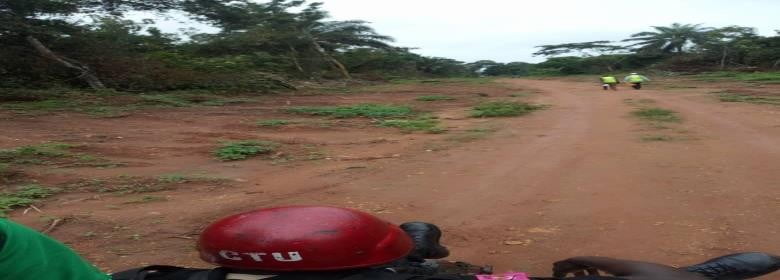
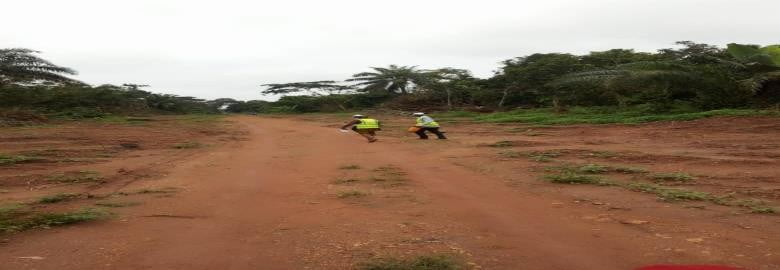 All three polling units cancelled in Orolu L.G.A were surrounded by bushes. There was no sign of human settlement in the vicinity. The buildings were dilapidated and abandoned. The grasses in the polling area surroundings seem to be newly cut for the election purpose.
Road to the Polling Units in Orolu L.G.A


 The mission visited Polling Unit 003 (Gbogbo primary School), Ward 09 (Olufon). There was a huge representation of the press, security personnel and observers (both international and local), but no voters.
INEC Officials at Gbogbo Primary School, Orolu L.G.A
Initially, the observer groups were required by the security forces to turn off all recording devices, but after a while, the order was lifted. Present was Bar. Festus Okoye, an INEC commissioner who addressed all present, citing that as at the said time – around 10.30am, “106 out of 167 people who collected their PVCs had voted and left”, and they were waiting for more voters to come before counting begins at 2pm.
Hitching a Ride on the Trunk of African Union Observer Group’s 4*4 vehicle, The AID Representatives made it to polling unit 004 (Idi Iya), Ward 8, (Olufon Orolu ‘H’).
 The AID Representatives on the way to polling Unit 004
 The AID Representatives on the way to polling Unit 004
Voters were transported by buses to the polling area. Present were media people, security forces, and observers.
The mission liaised with the European Union observer team who confirmed that as at the time, voting activity seem normal. There INEC officials reported no major hindrance in the electoral process
 * The AID Representatives with European Union Observers at Orolu L.G.A
 * The AID Representatives with European Union Observers at Orolu L.G.A
 From PU 004, the mission visited polling unit 001 (Kajola Village), Ward 008 (Olufon Orolu). This polling unit was off the major entrance. The access road was so horrible that international observers present at the other two polling units opted not to visit.
Representatives of The AID and Election Monitor Observer Groups on the Way to Kajola Village
 Polling Unit 001(Kajola Village) in Orolu L.G.A
There was more security personnel present at this polling unit than the other two. There were fewer voters present, transported with buses to the location. Cars from Osun state government house were parked at the vicinity. INEC officials reported no hindrance in the execution of the voting exercise.
However, the ballot area seemed insecure as individuals suspected to be party agents kept hovering and whispering into the ears of the voters while at the voting cubicle.
Most voters at the three polling units were interviewed on the initial violent activity reported in the area but they refused to speak on the matter. One woman in the kajola village polling unit wanted to speak to us but was warned by another voter to stop.
But the mission interviewed people around the three poling units and in the village, outside the polling area. Most responses centred around the fact that voters who identify with the opposition party were intimidated and turned away at the entrance of the polling area by the security forces. Giving access to mostly the supporters of the Incumbent party and turning away the opposition systematically guarantees ballot victory for the incumbent in Orolu Local Government.

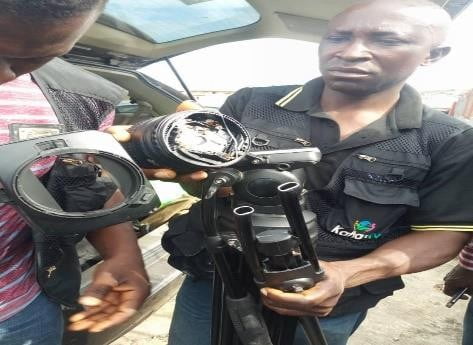

 The mission was alerted on violent activities happening in Osogbo and set out for the location. Upon arriving, it was gathered that members of KAFTAN TV, an accredited media entity was attacked outside the polling unit and rushed to a nearby hospital.
KAFTAN TV crew attacked near the polling Unit in Osogbo
They were reportedly attacked by political thugs with cutlasses, sticks, etc outside the polling unit 017 in Osogbo. Their bodies were bruised, and their equipment were broken beyond repair
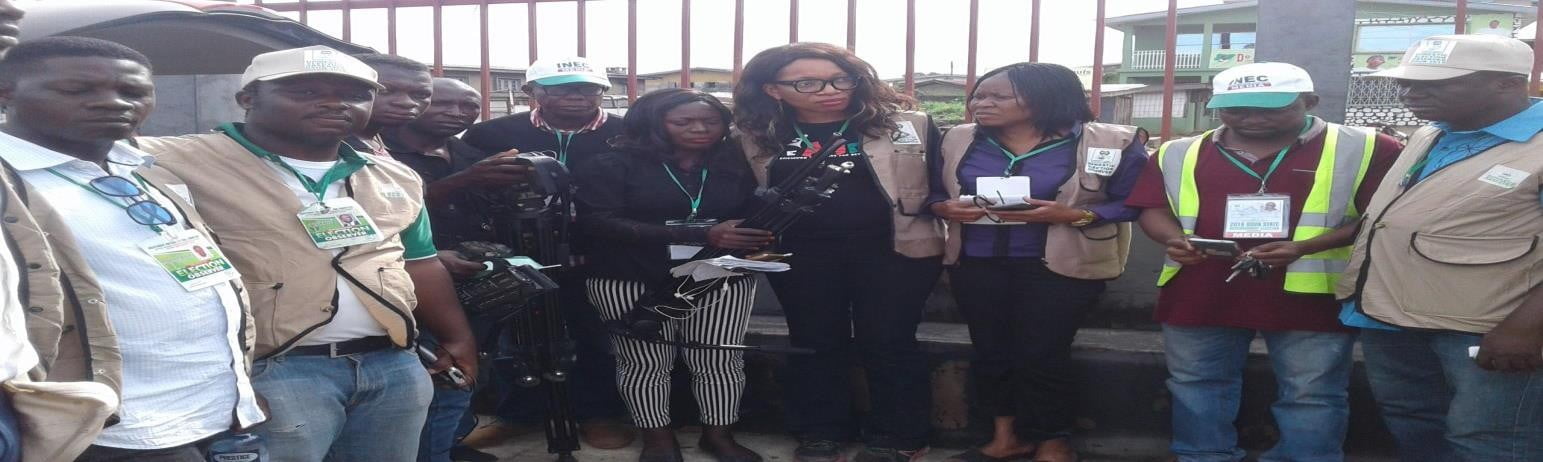 The mission visited the attacked persons in the company of the Women Arise for Change Initiative and Election Monitor observer group; and commiserated with the victims.
The AID, Election Monitor and Women Arise for Change representative Visit KAFTAN TV at the Hospital
Collation
Counting started in most polling units around 2pm, the official time stipulated by INEC. Counting was mostly done in an open and transparent manner by INEC officials in the presence of the voters, observers, security personnel and party agents. The results were publicly announced by the presiding officer. Polling unit 17 in Osogbo LGA is an example; there, counting was peaceful, and the electorate noted the individual number of votes casted for each candidate.
Announcement
The mission headed back to the state collation centre at INEC headquarters in Osogbo for final collation and announcement of result. Announcement of the results started at about 8pm on Thursday, the 27th of September 2018. At
about 8.15pm, Mr Dele Adeleke, a PDP chieftain refuted the figures, citing incoherence with the actual numbers from the original election. The Returning officer advised Mr Adeleke to seek justice in court if he finds discrepancies in the result.
He signalled the process to continue and plead for no further interference.
Breakdown of the Osun Governorship election rerun result
| S/N | L.G. A | Ward | Polling Unit | APC Result | PDP Result |
| 1 | Ife North | 10 | 2 | 126 | 2 |
| 2 | Ife South | 8 | 10 | 172 | 21 |
| 7 | 12 | 283 | 15 | ||
| 3 | Orolu | 8 | 1 | 111 | 3 |
| 8 | 4 | 128 | 55 | ||
| 9 | 3 | 41 | 64 | ||
| 4 | Osogbo | 5 | 17 | 299 | 165 |
| Total Votes | 1160 | 325 | |||
| Previous Total Votes | 254,345 | 254,698 | |||
| New Total Votes | 255,505 | 255,023 |
Having collated the figures above, Mr. Gboyega Oyetola of the All Progressives Congress was declared winner by the Returning Officer at about midnight, beating Senator Ademola Adeleke of the People’s Democratic Party (PDP) with 482 votes. No cancelled votes were reported in the rerun.
Notable Improvements During the Polling Exercise
Compared to previous elections, the mission observed some improvement. They include :
- In most polling units, including those in remote areas, card readers worked perfectly. In the event of card reader failure, technicians were available to either exchange the machine, or fix the problem. This made accreditation and voting easier and faster.
- INEC’s “ Stop Vote Buying Campaign” drastically reduced the incidence of openly enticing voters with money at the polling unit. The mission was informed that political parties paid between 1,500 – 2,500 naira per vote , but it was not physically observed at the polling unit.
- INEC’s voter awareness campaign increased the turnout of female voters. In the election, 52% of registered voters were women while 48% were men.
Notable Challenges During the Polling Exercise
The mission observed some challenges during the polling exercise. These challenges must be fixed before the next elections to increase the validity of the democratic process.
The challenges include –
- There was scattered rainfall across the state during the rerun election; as a result, some voters decided to stay indoors.
- In some rural areas, the polling units were either over-crowded, far away from some voters or the road was not accessible.
- Card readers failed to capture the finger prints of some rural dwellers.
- The INEC procedures were inconsistently followed in some polling units, leading to some vote cancellation.
- There was prolonged waiting time between voting and final collation, raising suspense amongst some stakeholders.
- Most people disagreed with INEC’s decision to declare the election Inconclusive, citing intimidation by the Incumbent power against the major opposition.
- There was a very low turnout of people with disabilities (PWD).
- There was widespread incidence of intimidation and violence during the rerun elections. Accredited observers were illegally arrested and detained by security forces, registered voters and press officials were intimidated and disfranchised by political thugs during the rerun elections.
Recommendations
- INEC can consider fixing the election days during the dry season, or on days with better rain forecast to avoid rainfall from preventing potential voters from exercising their civic rights.
- INEC can consider making sure that a polling unit exists within a particular distance per settlement. They can either create more polling units in rural areas with deficient numbers, or provide more vehicles to transport willing voters to and from the nearest polling units, or lobby the government to construct access roads to all polling units, or move inaccessible polling units to a better, accessible location.
- INEC must perfect the card readers to capture fingerprints of both urban and rural dwellers.
- INEC must continue voter education for both its staff and the electorate.
- INEC must provide tougher sanctions on any staff that fail to follow the standard procedure without adequate reason.
- INEC can opt for electronic collation system where Electoral Officers at the wards or local government headquarters can collate figures, and it will be viewed in real time at the state collation centre by all interest groups.
This will reduce mathematical error, time spent in manual collation, and mistrust in the commission’s collation process.
- INEC must check and balance its rules and regulations; and ensure that it aligns with the people’s choice, to maintain
the trust and respect of the people.
- INEC must improve the design of its voter awareness campaign to attract and accommodate more PWD numbers to the polling unit.
- INEC must increase the “no violence” campaign, build better coalition, provide more training, negotiate and enforce heavy sanction any member of the security forces and political parties found guilty of intimidating the electorate and stakeholders during the election.
Conclusion
- Based on the general conduct of all the actors in the 2018 0sun Governorship Election, The AID observation team concludes that the election conducted on Saturday, the 22nd of September8 2018 was Credible; while the Rerun Election conducted on Thursday, the 27th of September 2018 was NOT credible.
The conduct of the first Election was termed credible as voters could exercise their rights without major interference by any electoral actor, especially the security forces.
The conduct of the Rerun Election was termed NOT credible as voters were intimidated and disenfranchised by security forces. Many incidences of violence were reported across all polling units, marring the “fairness” of the election
The mission wishes to commend:
- The Presidency for creating the enabling environment for election conduct.
- INEC leadership and staff for its commitment, strength, innovative ideas and dedication towards making sure that the Nation’s democracy is sacrosanct.
- Political Parties and its Candidates for their commitment towards maintaining peace and order during and after the electoral process. We especially pray all stakeholders to remain calm and maintain national peace, while all matters arising from the exercise are interpreted by the judiciary.
- The Electorate for fully embracing democracy and coming out en-masse to exercise their civic rights.
The mission wishes to send heartfelt condolences to families that lost their loved ones during the exercise. We pray their souls rest in perfect peace, Amen
For More Inquiries, Please Contact Us

HEAD OFFICE: #11926 York Ave, #E, Los Angeles CA 90250, USA
BRANCH OFFICE: Plot 10A Akintunde Adeyemi Street, Lekki Phase 1, Lagos, Nigeria.
No. 8 Lola Close off Luanda Crescent, Wuse 2 Abuja. No. 78 Modebe Avenue, Onitsha, Nigeria
EMAIL: info@theaid.org
theaidorg@yahoo.com WEBSITE: www.the-aid.org PHONE: +13232443149
+2349037391547